


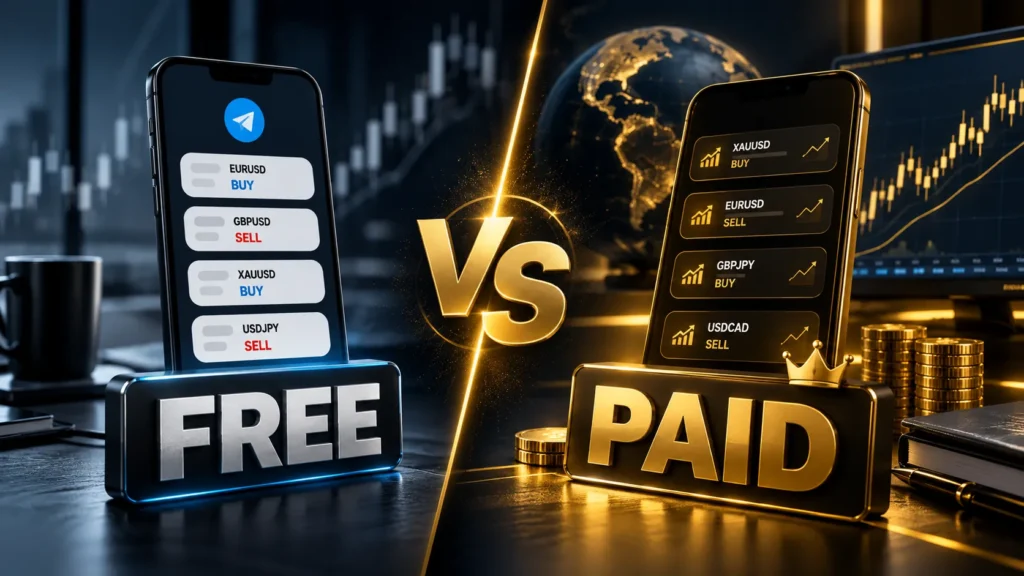
Forex signals can save traders time by providing a structured trade idea, usually with a currency pair, entry price, stop-loss level and take-profit target. But one question comes up constantly: are paid forex signals actually better than free forex signals?
The short answer is not automatically.
Free signals can be useful for learning and testing a provider before spending money. Paid signals may provide more frequent alerts, deeper analysis, faster updates and additional support. However, price alone does not tell you whether a signal is reliable.
The real difference between free vs paid forex signals comes down to transparency, timing, risk management, consistency and the level of service surrounding each trade.
What Are Free Forex Signals?
Free forex signals are trading ideas shared without requiring a subscription fee. They are commonly distributed through Telegram, WhatsApp, email, websites and trading communities.
A typical forex signal may contain:
- Currency pair
- Buy or sell direction
- Entry price or entry zone
- Stop-loss level
- Take-profit target
- Sometimes a short market explanation
Free signals are particularly useful when you want to understand how forex trading signals work before committing to a paid service.
However, “free” does not mean risk-free. A free signal can still be poorly timed, incomplete or based on weak analysis.
What Are Paid Forex Signals?
Paid forex signals are available through a subscription, premium membership or private trading community.
Depending on the provider, subscribers may receive more frequent setups, faster notifications, detailed technical or fundamental analysis, trade-management updates and direct support.
A good paid forex signal service should provide more than simply a higher number of signals.
Its value should come from:
- Clear entry and exit information
- Defined risk management
- Consistent delivery
- Useful market analysis
- Transparent trading history
- Trade updates when market conditions change
Most importantly, paying for forex signals does not guarantee profitable trades. Every setup can still lose.
Free vs Paid Forex Signals: Quick Comparison
| Feature | Free Forex Signals | Paid Forex Signals |
|---|---|---|
| Cost | No subscription | Subscription required |
| Signal frequency | Often limited | Usually more frequent |
| Entry, SL & TP | Varies | Usually structured |
| Market analysis | Basic or limited | Often more detailed |
| Trade updates | May be limited | More commonly available |
| Support | Usually minimal | May include support |
| Performance history | Varies widely | Should be easier to review |
| Best suited for | Testing & beginners | Traders wanting a fuller service |
Are Paid Forex Signals More Accurate?
Not necessarily. A higher subscription price does not automatically mean higher forex signal accuracy.
A paid provider can still produce losing trades, while a well-managed free forex signal channel may provide useful setups.
Instead of focusing only on advertised win rates, check:
- Are losing trades also shown?
- Are signals posted before the market moves?
- Does every setup include a stop loss?
- Are results tracked over a meaningful period?
- Is drawdown visible?
- Are old losing signals deleted or edited?
- Is the risk-to-reward ratio reasonable?
This is also important when comparing the best forex signal providers. Transparency matters more than an impressive screenshot or isolated winning trade.
Why Do Providers Offer Free Forex Signals?
Not every free forex signal service is unreliable.
Many providers use free signals as a way for traders to test their service before joining a premium membership.
This can actually be useful.
A free channel allows you to observe:
- How signals are formatted
- How quickly alerts arrive
- Which markets are covered
- How losing trades are handled
- Whether stop-loss levels are provided
- How often setups are posted
The more important question is not simply “Why is it free?”
Ask:
“Is the provider transparent about how its service works?”
Be especially careful when a provider uses free signals to push guaranteed profits, unrealistic returns or aggressive deposit offers.
When Are Free Forex Signals Better?
Free forex signals may be the better option if you are:
- New to trading signals
- Testing a new provider
- Practicing with a demo account
- Trading with a small account
- Comparing multiple providers
- Learning entries, stop losses and targets
For beginners, free signals offer a practical way to observe a service before adding another monthly expense.
However, even a good trading signal cannot protect an account from poor position sizing. Understanding forex risk management tools is equally important.
When Are Paid Forex Signals Worth Paying For?
Paid forex signals may be worth considering when the premium service provides clear additional value.
For example, a paid service may make sense if it offers:
Faster Alerts
Timing matters. If an entry is shared after the price has already moved significantly, following the original setup may change the risk-to-reward ratio.
Better Trade Management
Premium services may send updates when a trade reaches a target, requires a stop adjustment or becomes invalid.
Detailed Analysis
Understanding why a trade exists can be more valuable than simply receiving “BUY EUR/USD.”
Consistent Support
Some traders value access to analysts, educational material or a trading community where they can ask questions.
The subscription cost should also make sense relative to your trading account. Traders should never feel pressured to take unnecessary trades simply to recover a monthly signal fee.
How to Choose Between Free and Paid Forex Signals
Use the same evaluation process for both.
First, monitor the provider for a reasonable period. One successful signal tells you very little about long-term consistency.
Second, check whether the signal can realistically be followed at the published entry price.
Third, examine risk before looking at potential profit.
A useful forex signal should clearly show where the trade idea becomes invalid through a defined stop-loss level.
Finally, avoid choosing a provider based only on testimonials, screenshots or claimed accuracy percentages.
Look at the process behind the results.
Which Is Better for Beginners?
For most beginners, starting with free forex signals makes more sense.
You can observe how a provider works without adding a subscription cost. More importantly, you can test signals on a demo account and learn how spreads, stop losses, risk-to-reward and position sizing affect the actual outcome.
Once you understand how signal trading works, you can decide whether upgrading to a paid service provides enough additional value.
Final Takeaway
The biggest difference between free vs paid forex signals is not simply accuracy.
It is usually the overall service surrounding the trade: signal frequency, delivery speed, analysis, risk management, trade updates, transparency and support.
Free forex signals can be valuable for learning and testing a provider. Paid forex signals can be useful when they provide a clearly better process and save you meaningful research time.
Neither option removes trading risk.
Always test a provider, review how it handles losses and use proper risk management before putting real capital at risk.
If you want trading insights or want to understand the signal options available through Daily Forex Trades, you can contact the Daily Forex Trades team.
FAQ's
Some free forex signals can be useful, but quality varies. Check the provider's trading history, signal timing, stop-loss levels and transparency before following any setup.
Not always. Paid services may provide more alerts, analysis and support, but paying a subscription does not guarantee better trading results.
Yes. Free signals can help beginners understand entries, stop losses and take-profit levels. Testing signals on a demo account first is a sensible approach.
Look for transparent results, realistic claims, clearly defined risk levels, consistent communication and a visible track record. Be cautious of guaranteed-profit claims.
Consider paying only when the premium service offers meaningful additional value, such as faster alerts, detailed analysis, trade updates, transparent results or useful support.