


If you are a Muslim who wants to trade, one question comes before any chart or strategy: is trading halal or haram?
Trading itself is halal. Buying and selling is an honoured way to earn in Islam, and the Qur’an says plainly that Allah has permitted trade and forbidden riba (2:275). What can make trading haram is the way it is done: paying or earning interest, betting on prices without owning anything, or dealing in forbidden businesses.
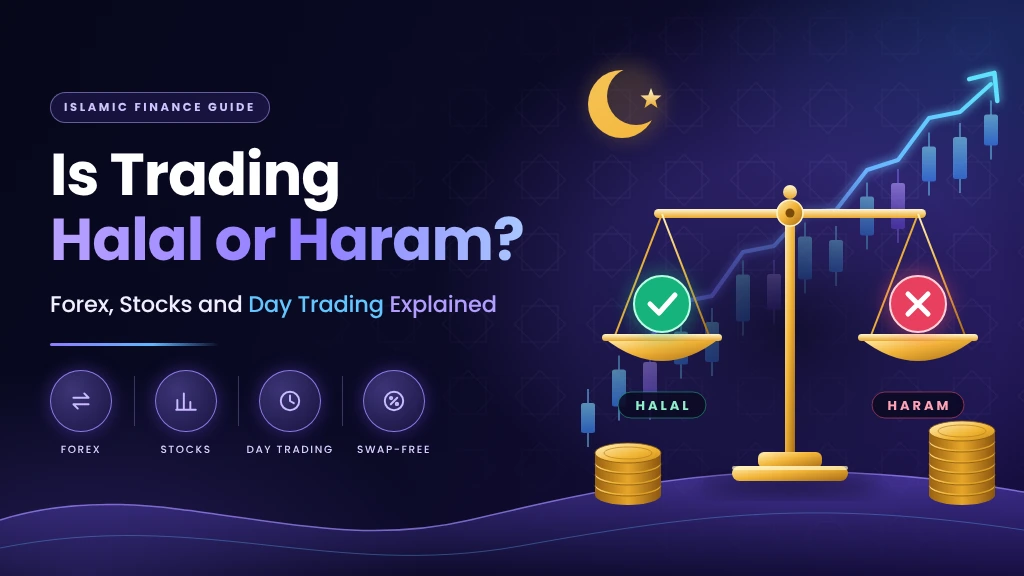
So the honest answer changes from market to market. Here is a quick view before we go through each one.
| Type of trading | Common ruling | What decides it |
|---|---|---|
| Halal (Shariah-compliant) stocks | Halal, but the list is limited | The company’s business and its debt |
| Spot forex and gold | Halal with conditions | Instant exchange, no swap interest |
| Day trading | Scholars differ | Owning the asset before you sell it |
| Funded (prop firm) accounts | Mostly not permitted | Simulated trades and challenge fees |
This guide is for education. For a ruling on your own situation, please ask a qualified scholar.
What makes a trade haram in Islam?
Islamic finance tests every deal against three things.
- Riba (interest). Any fixed extra paid on a loan. In trading it shows up as overnight swap fees and margin loans.
- Gharar (too much uncertainty). Deals where the buyer does not really know what they own or when they will receive it.
- Maysir (gambling). Putting money on an outcome with no real asset or analysis behind it.
There is a fourth check, and it is the asset itself. Shares in alcohol, gambling or interest-based banks are off the table however you trade them.
Keep these four points in mind and most questions about trading in Islam become much easier to answer.
Is forex trading halal?
Exchanging one currency for another is allowed. The condition comes from a well-known hadith: when two different currencies are exchanged, the deal must be completed on the spot, hand to hand. Scholars who permit forex today treat the instant settlement of a spot trade as meeting that condition.
The problems start with how most retail forex works.
- Swap fees. Hold a position overnight on a normal account and you pay or receive interest. That is riba.
- Leverage. The broker lends you money to open a bigger position. Many scholars object, because a loan that brings the lender a benefit is treated as riba.
- CFDs. With most online brokers you never own the currency. You hold a contract on its price, and stricter scholars see that as closer to betting than trading.
This is why Islamic forex accounts exist. They are also called swap-free accounts, and they remove the overnight interest. That fixes one problem, not all of them. Check that the broker has not simply renamed the swap as an “admin fee”, and keep leverage low or avoid it.
If you follow trade ideas from other people, the same rules apply to every trade you copy. Our guide on what forex trading signals are explains how they work, so you can judge whether a setup fits your limits.
Gold needs an extra note. It is one of the items named in the hadith, so anyone using gold trading signals should trade them on a spot, swap-free basis only.
Are stocks halal or haram?
Buying a share means owning a small part of a real business, so stock trading is the easiest case. Most scholars allow it when two checks pass.
- The business is halal. No alcohol, gambling, pork, adult content, or conventional banking and insurance.
- The finances are clean. Widely used Shariah screens, such as the AAOIFI standard, cap interest-bearing debt at about 30% of the company’s market value and income from haram sources at about 5%.
If a company earns a small amount from interest, you give that share of your profit to charity. This is called purification.
These checks leave a limited list of halal, Shariah-compliant stocks. Run every company through a Shariah stock screener before you buy.
So is the stock market haram? No. It turns haram when you buy the wrong companies, borrow on margin, or short sell shares you do not own.
Is day trading halal?
Here scholars are divided, and it is better to say so openly.
One group says yes, with conditions. Islamic law sets no minimum time for holding something you own. Buying a halal share in the morning and selling it in the afternoon is an ordinary sale.
The other group says no. Darul Ifta Birmingham, a UK fatwa body, has ruled that shares take time to settle in your account, and you cannot sell what you do not yet fully own. Some scholars also feel that rapid buying and selling looks too much like gambling.
If you follow the first view, keep to these limits:
- Trade only screened halal shares or spot instruments
- Use a cash account with your own money, no margin
- No holding positions overnight
- Take trades from analysis, not from impulse
Day trading is also hard on the wallet. The US Securities and Exchange Commission warns that day trading is a complicated form of investing that often relies on borrowed money.
Not sure which style suits you? Read our breakdown of the difference between scalping and day trading first.
Are funded trading accounts halal?
Prop firms sell a paid challenge and give a “funded” account to traders who pass. Most of these accounts are simulated, and payouts come largely from the fees of traders who failed.
Darul Ifta Birmingham has ruled this model not permissible. No real trade takes place, and the fee buys nothing of real value. The same ruling covers firms that hand out real capital for conventional products, so ask a scholar before you pay for any challenge.
Brokers that offer swap-free accounts
If you decide to trade, the account type matters as much as the strategy. These four well-known brokers all offer a swap-free option.
| Broker | Swap-free option | Check before you open |
|---|---|---|
| Exness | Usually applied automatically for clients in Muslim-majority countries | Fewer instruments are covered if you live elsewhere |
| XM | Islamic status on request from the Members Area | Which instruments stay swap-free |
| IC Markets | Swap-free on Standard and Raw Spread accounts | A flat holding fee applies to positions kept overnight |
| Vantage | Swap-free Standard STP and Raw ECN accounts | An admin fee replaces the swap, and Vantage does not claim Shariah compliance |
A swap-free label is a starting point, not a ruling. Trading on these accounts is still CFD-based, so the points in the forex section above apply. Ask the broker for its fee list in writing, then check it with a scholar.
Ready to start?
- Open an Exness account
- Open an XM account and claim your deposit bonus
- Open an IC Markets account and get your deposit bonus
- Open a Vantage account and check the gold cashback offer
Bonuses and cashback depend on your country and account type, and may not apply to swap-free accounts. Terms apply, so read the broker’s offer page before you deposit.
Disclosure: some links in this section are affiliate links. We may earn a commission if you open an account, at no extra cost to you.
How to keep your trading halal
- Trade assets you actually own: shares, or spot currencies and metals
- Use a swap-free account and read the fee list for hidden charges
- Stay away from margin loans, short selling and futures
- Screen every stock before you buy it
- Base each trade on analysis, never on a hunch
- Where scholars differ, take the more cautious view
Conclusion
Trading is not haram in Islam. Interest, gambling and selling what you do not own are.
Stocks in halal companies are the clearest case. Spot forex and gold can be halal on a genuine swap-free account. Day trading is disputed, and most funded accounts are best avoided.
Rulings also differ between scholars and schools of thought, so treat this guide as a starting point. Set your limits first, then build your strategy inside them. If a trade still feels doubtful, speak to a scholar you trust before you place it.