



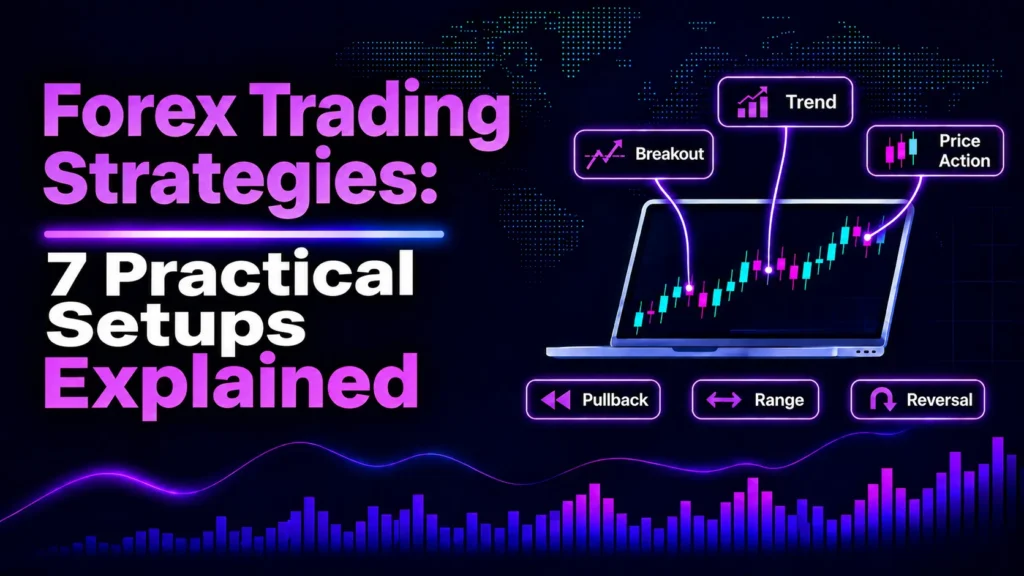
Forex trading strategies are planned methods for deciding when to buy or sell currency pairs, where to exit, and how to limit potential losses. Popular approaches include price action, trend following, breakout trading, scalping, day trading, swing trading, and range trading.
A strategy gives traders rules to follow instead of reacting to every price movement. However, no method works reliably in all market conditions.
For beginners, the challenge is choosing an approach that matches their experience, available time, and risk tolerance.
This guide explains seven forex strategies, when traders use them, common mistakes, and practical ways to manage risk.
What Are Forex Trading Strategies?
A forex trading strategy is a set of conditions used to evaluate currency market opportunities.
Most strategies consider price direction, entry levels, position size, and planned exits.
For example, a trader might wait until EUR/USD approaches a previously tested support level before examining a potential buy setup.
Support is an area where buying interest has previously appeared. Resistance is an area where selling pressure has previously increased.
A strategy helps organise these observations, but it cannot predict future prices with certainty.
Beginners can start by understanding forex trading indicators and how technical tools relate to price behaviour.
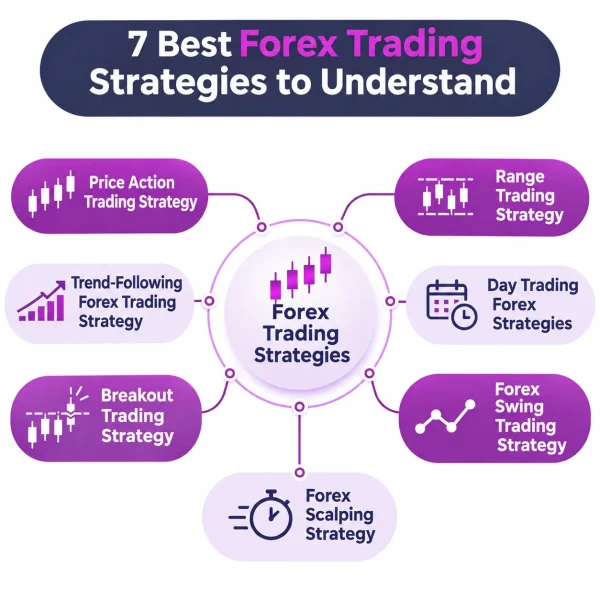
7 Best Forex Trading Strategies to Understand
The following methods serve different purposes. Some focus on short price movements, while others examine trends that develop over several days.
| Strategy | Main approach | Important limitation |
| Price action | Analyse candles and price levels | Chart patterns can fail |
| Trend following | Trade in the prevailing direction | Trends can reverse |
| Breakout trading | Watch important price boundaries | False breakouts |
| Range trading | Study sideways markets | Sudden range breaks |
| Day trading | Close positions within the day | Requires regular monitoring |
| Swing trading | Hold positions across sessions | Overnight and weekend risks |
| Scalping | Target brief price movements | Spread and execution costs |
1. Price Action Trading Strategy
A price action trading strategy focuses on how prices move rather than relying entirely on indicators.
Traders examine candlestick patterns, support and resistance, and the structure of recent price movements.
For example, if GBP/USD repeatedly rejects a resistance area, traders may watch for signs that buying pressure is weakening.
However, an earlier reversal does not mean the same reaction will happen again.
Best understood through: Price charts, market structure, and clearly defined entry rules.
2. Trend-Following Forex Trading Strategy
Trend following involves assessing whether a currency pair is moving mainly upward or downward.
A rising market may form higher highs and higher lows. A falling market may show the opposite pattern.
Some traders use moving averages to help identify the prevailing direction.
The aim is to examine setups that agree with the wider trend rather than constantly attempting to predict reversals.
Main risk: A trend may weaken or reverse before the trader recognises the change.
3. Breakout Trading Strategy
Breakout trading begins with identifying a price boundary that the market has struggled to cross.
Suppose EUR/USD has repeatedly stopped rising near a resistance area.
A movement above that area may attract attention from traders looking for a possible change in market behaviour.
Some wait for price to remain above the level before evaluating an entry.
Main risk: Price can briefly cross resistance and fall back, creating a false breakout.
4. Range Trading Strategy
Currency markets sometimes move sideways rather than developing a clear trend.
During these periods, prices may repeatedly fluctuate between support and resistance.
Range trading involves studying those boundaries and assessing whether the market continues respecting them.
The approach may be easier to recognise when price movements remain relatively stable.
Main risk: Economic announcements or stronger market participation can cause the range to break unexpectedly.
5. Day Trading Forex Strategies
Day traders normally open and close positions within the same trading day.
They often examine intraday trends, economic announcements, and activity during major financial sessions.
This approach requires attention because price conditions can change quickly.
Day trading can also involve frequent transactions, making spreads and execution costs important.
Main risk: Rapid decisions and repeated trading can increase losses when discipline breaks down.
6. Forex Swing Trading Strategy
Swing trading focuses on market movements that develop across several days.
Instead of constantly monitoring small price changes, swing traders examine broader price structure and economic developments.
A trader might study whether a currency pair is recovering from support within a larger upward trend.
This approach may require less frequent chart monitoring than scalping.
Main risk: Positions held overnight may face financing costs, unexpected news, and weekend price gaps.
7. Forex Scalping Strategy
Scalping involves entering and exiting trades over short periods.
A scalper may monitor small price movements during active market sessions.
Because the expected movement can be limited, transaction costs and execution quality become especially important.
Scalping also demands quick decisions and a clear plan for stopping losses.
Main risk: Slippage, widening spreads, and impulsive trading may undermine the setup.
How to Choose Forex Strategies for Beginners
The best forex trading strategies are not necessarily the most complicated.
A beginner should first consider how much time they can spend watching the market.
Someone with limited availability may find longer-term chart analysis easier to study than rapid intraday trading.
Next, consider the currency pair.
Major pairs often attract substantial trading activity, but their volatility and spreads still change throughout the day.
For a clearer starting point, forex pairs for beginners explains how different currencies can affect trading conditions.
Finally, choose a strategy whose rules are easy to describe and test.
A method you understand is more useful for learning than one followed only because another trader recommends it.
How to Build Your Own Forex Trading Strategy
Rather than combining several strategies immediately, beginners can work through a simple planning process.
- Choose a currency pair: Focus on a market whose behaviour you can study consistently.
- Select a trading style: Decide whether to examine short intraday setups or longer price movements.
- Define an entry condition: Identify what must happen before considering a position.
- Plan the exit: Decide where the setup would become invalid.
- Check the position size: Estimate the financial loss that could occur if the trade moves against you.
- Practise the rules: Use historical charts and demo trading to identify weaknesses.
- Keep records: Compare planned decisions with actual execution.
For example, a beginner studying trend following might wait for a currency pair to pull back toward a previously respected support area.
The trader would then assess whether the wider trend remains intact and whether the possible loss is acceptable.
This is an example of market analysis, not an instruction to open a trade.
Forex Risk Management Strategies Every Beginner Needs
Even a clear trading method can experience repeated losses.
Risk management determines how much financial exposure a trader accepts when an idea proves incorrect.
Position Sizing
Position size affects how strongly a price movement changes the value of a trade.
A large position can create substantial losses even when the market moves only a short distance.
Traders should understand the contract specifications before choosing their exposure.
Stop-Loss Planning
A stop-loss order is intended to close a position when price reaches a specified level.
However, execution can differ from the requested price during fast markets or gaps.
Stop losses should be considered alongside position sizing, not as a guarantee against unexpected losses.
Leverage and Trading Costs
Leverage allows traders to control market exposure greater than the money initially committed.
It can magnify both gains and losses.
The US Commodity Futures Trading Commission outlines important risks of retail forex trading, including leverage and the need to examine trading providers carefully.
Traders should also review spreads, commissions, and applicable overnight charges.
Common Mistakes That Weaken Forex Trading Strategies
Many trading problems arise from how a strategy is applied rather than the strategy’s name.
- Switching methods too often: Changing rules after every unsuccessful trade makes it difficult to evaluate an approach.
- Ignoring market conditions: A method designed for trending prices may behave poorly in a sideways market.
- Adding unnecessary indicators: Too many tools can create conflicting information.
- Following unverified signals: A suggested trade should not replace independent analysis.
- Increasing exposure after losses: Attempting to recover losses quickly can create even greater financial risk.
The US Securities and Exchange Commission explains forex trading risks for individual investors, including the potential consequences of leveraged positions.
A trading journal can help beginners recognise these mistakes before they become repeated habits.
How Do You Know Whether a Forex Strategy Fits You?
A practical strategy should have understandable entry rules, realistic monitoring requirements, and defined risks.
Ask yourself whether you can explain why a trade would be considered, what would invalidate the setup, and how much you could lose.
Historical testing and demo trading can help identify possible weaknesses, but simulated results do not establish future profitability.
Readers examining different methods may also benefit from understanding why trading strategies can fail, particularly when claims are difficult to verify.
The objective is to improve the quality of trading decisions rather than constantly search for a perfect technique.
Conclusion
Understanding forex trading strategies gives beginners a foundation for studying how currency prices behave and how trading decisions are structured.
Price action, trend following, breakouts, ranges, day trading, swing trading, and scalping each have different strengths and limitations.
No strategy can remove uncertainty from financial markets.
Beginners should focus on clear rules, practical testing, appropriate position sizes, and consistent risk management.
Daily Forex Trades provides additional forex trading education and market insights for readers developing their understanding of currency markets.
Risk Disclaimer: Forex trading involves substantial financial risk. Leverage, slippage, volatility, and unexpected market movements can result in significant losses. No trading strategy guarantees profits. This article is intended for educational purposes and does not constitute personalised financial advice.
FAQ's
Forex trading strategies are planned methods for analysing currency pairs, identifying possible entries, managing risk, and deciding when to exit positions.
Beginners may find clearly defined price action or trend-following methods easier to study. Suitability depends on experience, available time, and acceptable risk.
It involves examining candlestick movements, support and resistance, and market structure to understand possible changes in price direction.
They can produce gains or losses. There is no guarantee of profitability, and frequent trading can increase transaction costs and execution risks.
Day trading generally closes positions within a trading day. Swing trading may keep positions open across several sessions.
Yes. Some traders focus mainly on price action, although indicators can provide additional information.
A false breakout can occur when price crosses an important level and quickly moves back in the opposite direction.
Risk management helps traders control position exposure and prepare for unfavourable price movements. It cannot eliminate losses.
Some concepts, such as trend following and support and resistance, apply to both markets. However, forex has different trading hours, market structures, and product risks.
No. Currency markets are uncertain, and even carefully tested strategies can produce losses under changing conditions.