



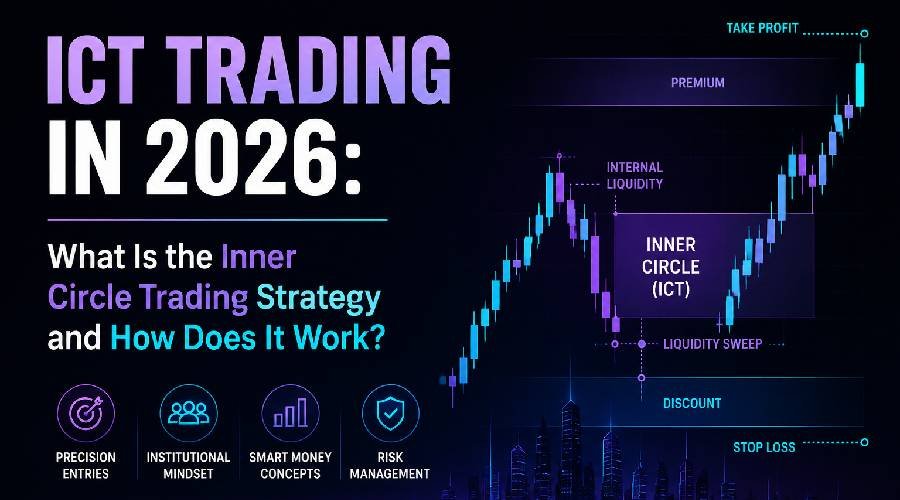
Forex trading is always. Traders are looking for ways to understand how the markets work better. One way that has become really popular is the ICT Trading Strategy.
The ICT Trading Strategy, or Inner Circle Trading, is about understanding how the market behaves by looking at liquidity, price action, and how big financial institutions trade. Using traditional indicators, ICT traders study how these institutions affect price movements.
In this guide, you will learn what the ICT Trading Strategy is, how it works, what the main ideas are, what the good and bad points are, and if it is worth learning in 2026.
What Is the ICT Trading Strategy?
The ICT Trading Strategy is a way of trading that was developed by Michael Huddleston, also known as ICT. It is based on the idea that financial markets are mostly controlled by institutions like banks, hedge funds, and investment firms. The ICT Trading Strategy teaches traders how to spot what these institutions are doing and use that information to make better trading decisions.
The ICT Trading Strategy is different from forex trading strategies because it does not rely on indicators. Instead, it focuses on:
- Market structure
- Liquidity
- Order flow
- Price action
- behavior
The goal is to help traders understand why prices move, rather than just reacting to what has already happened.
Why Is the ICT Trading Strategy Popular in 2026?
The ICT Trading Strategy is becoming more popular because traders are getting more interested in Smart Money Concepts. There are reasons for this:
- There is a lot of free educational content online
- More people are aware of liquidity-based trading
- There is an understanding of how institutions behave in the market
- More people are looking for price action trading strategies
Many traders think that the ICT Trading Strategy gives them a deeper understanding of how the market works, compared to traditional indicator-based systems.
The Main Ideas of the ICT Trading Strategy
To understand the ICT Trading Strategy you need to learn its concepts.
1. Market Structure
Market structure refers to the direction of the market. An uptrend happens when the price makes highs and higher lows. A downtrend happens when the price makes highs and lower lows. Understanding market structure helps traders decide whether to buy or sell.
2. Liquidity
Liquidity is a concept in the ICT Trading Strategy. It refers to areas where there are a lot of stop-loss orders and pending orders. Institutions often target these areas before moving the market. Common liquidity zones include highs, equal lows and the previous days high and low.
3. Institutional Order Flow
Big institutions cannot place orders without affecting the price. So they often create temporary market moves to gather liquidity before entering a position. ICT traders try to spot these activities and trade accordingly.
4. Liquidity Sweeps
A liquidity sweep happens when the price moves beyond a support or resistance level to trigger stop losses. Many new traders think these moves are breakouts. Ict traders see them as opportunities because the market often reverses after collecting liquidity.
Important ICT Concepts
Here are some ICT concepts every trader must know:
Fair Value Gap
A Fair Value Gap is a price imbalance that happens when the market moves strongly in one direction. This creates a gap between buyers and sellers. ICT traders think that the price often returns to these gaps before continuing its trend. Fair Value Gaps are commonly used as entry points.
Order Blocks
Order Blocks are areas where institutions are thought to have placed orders. A bullish order block may act as support while a bearish order block may act as resistance. These zones help traders spot market reversals or continuation opportunities.
Breaker Blocks
Breaker Blocks happen when an order block fails and changes its role. For example a support zone may become resistance after being broken. Many ICT traders use breaker blocks as confirmation for trade entries.
Optimal Trade Entry
The Optimal Trade Entry concept uses Fibonacci retracement levels to spot high-probability entry zones. Traders usually focus on the area between 62% and 79% Fibonacci retracement. This zone is considered good for entering trades while maintaining risk-to-reward ratios.
Premium and Discount Zones
ICT traders often divide a price range into two sections: the premium zone and the discount zone. The premium zone is the priced area, suitable for potential selling opportunities. The discount zone is the priced area, suitable for potential buying opportunities. This concept helps traders avoid entering positions at prices.
How the ICT Trading Strategy Works
Step 1: Identify Market Bias
Start by analyzing timeframes, such as the daily chart or the 4-hour chart. Determine whether the market is bullish or bearish.
Step 2: Locate Liquidity Areas
Mark important liquidity zones, including highs, equal lows and the previous sessions highs and lows. These areas often attract attention.
Step 3: Wait for a Liquidity Sweep
Once entered, wait for the market to sweep liquidity. This helps reduce the risk of being caught in breakouts.
Step 4: Find Confirmatio
Look for Fair Value Gaps, Order Blocks, and market structure shifts. These confirmations increase the probability of a trade.
Step 5: Manage Risk
Risk management is crucial. Many professional traders risk 1% to 2% of their account per trade. A good risk-to-reward ratio is often 1:2 or higher.
The Benefits of the ICT Trading Strategy
The ICT Trading Strategy teaches traders how the market works, rather than just following indicators.
- It helps traders identify high-quality trade setups by focusing on liquidity and institutional activity.
- The ICT concepts can be used in markets, including Forex, Gold, Stock Indices and Cryptocurrencies.
- The strategy also encourages disciplined stop-loss placement and structured trade planning.
The Risks and Limitations of the ICT Trading Strategy
Despite its popularity, the ICT Trading Strategy is not perfect. It has a steep learning curve, and many concepts can be difficult for beginners to understand.
- ICT setups may not appear frequently, requiring traders to wait for quality opportunities.
- Emotional discipline is essential, and even the best strategy can fail if traders ignore risk management.
- There are no guaranteed profits, and losses are part of trading.
The ICT Trading Strategy vs Traditional Indicator Trading
Many traders compare ICT Trading with indicator-based systems.
ICT Trading | Indicator Trading |
Focuses on price action | Relies on indicators |
Uses liquidity concepts | Uses historical calculations |
Studies institutional behavior | Studies technical signals |
Less chart clutter | More chart tools |
Neither approach is universally better.
The best choice depends on a trader’s personality, goals, and experience level
The Best Markets for the ICT Trading Strategy in 2026
Forex is a market for the ICT Trading Strategy, especially major currency pairs like
- EUR/USD
- GBP/USD
- USD/JPY.
- Gold Trading is also a market among ICT traders.
- Stock Indices, such as NASDAQ, S&P 500 and Dow Jones often display liquidity-driven movements.
- Cryptocurrencies like Bitcoin and Ethereum are becoming increasingly popular among traders applying ICT concepts.
Tips for Beginners Learning the ICT Trading Strategy
If you are new to the ICT Trading Strategy, start with market structure and master trend analysis before learning concepts.
- Learn one concept at a time and practice on a demo account to build confidence.
- Keep a trading journal to record your entries, exits, mistakes, and lessons learned.
- Focus on consistency.
- Remember that success in trading comes from discipline and risk management rather than finding a perfect strategy.
Conclusion
The ICT Trading Strategy has become one of the discussed approaches in modern forex trading. By focusing on liquidity, market structure, Fair Value Gaps, Order Blocks and institutional behavior, traders gain an understanding of how financial markets operate. While the ICT Trading Strategy offers insights into smart money movements, it also requires patience, education, and strong risk management skills. Beginners should take time to study the concepts and practice on demo accounts. Develop a structured trading plan before risking real capital.
Stay ahead of the markets with CarlDupoin. Get expert macroeconomic insights, institutional-grade analysis, and actionable trading intelligence that helps investors navigate uncertainty and identify opportunities with confidence.
FAQ
What is the ICT Trading Strategy?
The ICT Trading Strategy is a trading methodology that focuses on market structure, liquidity, institutional order flow and price action to identify high-probability trading opportunities.
Is the ICT Trading Strategy suitable for beginners?
Yes beginners can learn the ICT Trading Strategy. It requires time, patience and consistent practice because the concepts are more advanced than many traditional trading methods.
What is a Fair Value Gap in the ICT Trading Strategy?
A Fair Value Gap is a price imbalance that happens during a market move. Traders often expect the price to revisit the gap before continuing in the direction.
Can the ICT Trading Strategy be used in markets, than Forex?
Yes the ICT concepts can be applied to Forex, Gold, Stock Indices, Commodities and Cryptocurrency markets.
Does the ICT Trading Strategy guarantee profits?
No the ICT Trading Strategy involves risk and success depends on analysis, discipline, risk management and consistent execution.