

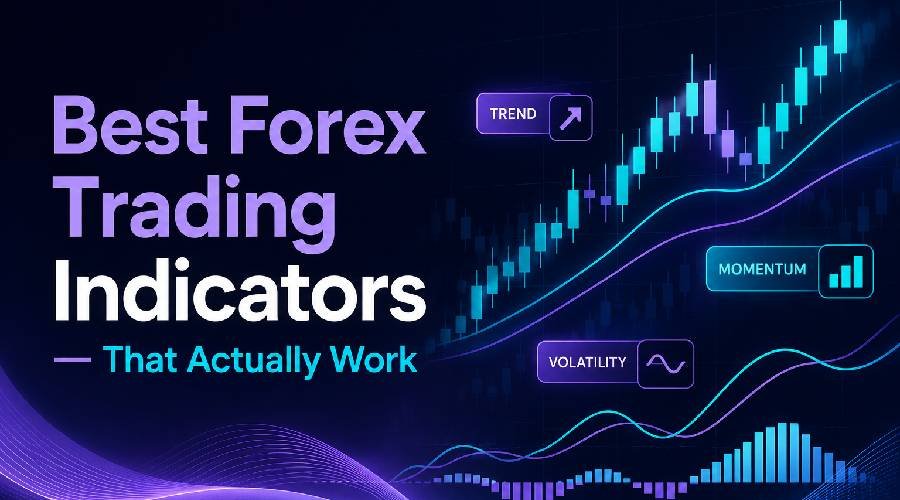
Every Forex trader wants one thing: a clearer view of the market before entering a trade. But with so many tools available, beginners often feel confused about which indicators to trust. The truth is simple: no indicator can guarantee profits, but the right indicators can help you understand trend direction, momentum, volatility, and possible entry points.
In this guide, we will cover the Best Forex Trading Indicators of All Time and explain how they actually work in 2026. Whether you are a beginner or improving your current strategy, these Forex technical indicators can help you make smarter trading decisions when combined with proper risk management.
Best Forex Trading Indicators of All Time for Beginners and Pro Traders
The Best Forex Trading Indicators of All Time are not magic tools. They are decision-support tools. Professional traders use them to confirm price action, identify market strength, and avoid emotional trading. Beginners should focus on simple indicators first instead of loading their chart with too many signals.
Below are the most useful and trusted indicators used in Forex trading.
1. RSI Indicator
– What It Is
The RSI indicator, or Relative Strength Index, is a momentum indicator that measures whether a currency pair may be overbought or oversold. It usually moves between 0 and 100.
– How It Works
When RSI moves above 70, the market may be overbought. When it moves below 30, the market may be oversold. However, this does not mean price will reverse immediately. In strong trends, RSI can stay overbought or oversold for a long time.
– Best Use Case
RSI works well for spotting possible reversals, especially when combined with support and resistance levels. It is also useful for divergence trading, where price moves in one direction but RSI shows weakening momentum.
– Beginner Tip
Do not sell only because RSI is above 70 or buy only because RSI is below 30. Always check the trend and market structure first.
2. MACD Indicator
– What It Is
The MACD indicator, or Moving Average Convergence Divergence, helps traders understand trend direction and momentum. It includes the MACD line, signal line, and histogram.
– How It Works
When the MACD line crosses above the signal line, it may show bullish momentum. When it crosses below the signal line, it may show bearish momentum. The histogram shows the strength of the move.
– Best Use Case
MACD is helpful for trend confirmation. Traders often use it to confirm whether a market has enough momentum before entering a buy or sell trade.
– Beginner Tip
MACD works better in trending markets than in sideways markets. Avoid using it alone during choppy price action.
3. Moving Average Indicator
What It Is
The Moving Average indicator smooths price data and shows the average price over a selected period. Common examples include the 50-day, 100-day, and 200-day moving averages.
– How It Works
If price is above a moving average, the market may be in an uptrend. If price is below it, the market may be in a downtrend. Traders also watch moving average crossovers for trend changes.
– Best Use Case
Moving averages are best for identifying trend direction. They can also work as dynamic support or resistance areas in trending markets.
– Beginner Tip
Use moving averages to understand the overall trend before taking trades. For example, if price is above the 200 moving average, beginners may focus more on buy setups.
4. Bollinger Bands
What It Is
Bollinger Bands are volatility indicators made of three lines: a middle moving average and two outer bands. The bands expand and contract based on market volatility.
– How It Works
When the bands widen, volatility is increasing. When they narrow, volatility is decreasing. Price touching the upper band may show strong buying pressure, while price touching the lower band may show strong selling pressure.
– Best Use Case
Bollinger Bands are useful for identifying volatility, breakout opportunities, and possible reversal zones.
– Beginner Tip
Do not assume price will reverse every time it touches a band. In strong trends, price can continue moving along the outer band.
5. Fibonacci Retracement
– What It Is
Fibonacci Retracement is a technical analysis tool used to find possible pullback levels in a trend. Common levels include 38.2%, 50%, and 61.8%.
– How It Works
Traders draw Fibonacci from a swing low to a swing high in an uptrend, or from a swing high to a swing low in a downtrend. These levels help identify areas where price may pause or continue the trend.
– Best Use Case
Fibonacci works best in trending markets. It helps traders find better entry points after price pulls back.
– Beginner Tip
Use Fibonacci with support, resistance, and candlestick confirmation. Do not trade a Fibonacci level blindly.
6. Stochastic Oscillator
– What It Is
The Stochastic Oscillator is a momentum indicator that compares the current price to its recent price range. Like RSI, it helps identify overbought and oversold conditions.
– How It Works
The indicator usually moves between 0 and 100. Readings above 80 may suggest overbought conditions, while readings below 20 may suggest oversold conditions.
– Best Use Case
The Stochastic Oscillator is useful in ranging markets where price moves between support and resistance.
– Beginner Tip
Avoid using Stochastic as your only signal. It works better when combined with price action and trend analysis.
How to Choose the Right Forex Indicator
Choosing the right indicator depends on your trading style. If you are a trend trader, Moving Averages and MACD may be more useful. If you trade reversals, RSI, Stochastic, and Bollinger Bands may help. If you trade pullbacks, Fibonacci Retracement can support your entries.
A simple beginner setup could include:
- Moving Average for trend direction
- RSI for momentum
- Support and resistance for entry zones
The best Forex strategy is not about using many indicators. It is about using a few tools correctly and consistently. If you still want to understand the basics before using indicators, start by learning What is Forex Trading and how the Forex market actually works.
Common Mistakes Traders Make With Indicators
Many beginners fail because they treat indicators like profit machines. Indicators should guide decisions, not replace thinking.
Avoid these mistakes:
- Using too many indicators on one chart
- Taking trades without checking price action
- Ignoring stop loss and risk management
- Using trend indicators in sideways markets
- Following signals without understanding the reason
- Changing strategies after one losing trade
Remember, even the best indicators for Forex trading can fail during high-impact news or unexpected market moves.
Conclusion
The Best Forex Trading Indicators of All Time include RSI, MACD, Moving Averages, Bollinger Bands, Fibonacci Retracement, and the Stochastic Oscillator. Each tool gives a different view of the market, but none of them should be used alone.
Successful traders combine indicators with price action, market structure, discipline, and strong risk management. If you want to trade smarter in 2026, focus on learning how each indicator works instead of searching for a perfect signal.
For deeper market insights, trading education, and professional tools, explore CarlDupoin trading insights and tools to support your Forex journey with more confidence.
FAQ
What is the most accurate Forex indicator?
There is no single most accurate Forex indicator. Many traders use a combination of Moving Averages, RSI, MACD, and support/resistance to confirm trade ideas.
Which Forex indicator is best for beginners?
The Moving Average indicator is one of the best Forex indicators for beginners because it helps traders identify trend direction in a simple way.
Can Forex indicators predict the market?
Forex indicators cannot predict the market with certainty. They analyze past and current price data to help traders make better decisions.
Are technical analysis indicators useful in Forex trading?
Yes, technical analysis indicators are useful when combined with price action, risk management, and proper trading discipline.
How many Forex indicators should beginners use?
Beginners should use two or three indicators at most. A simple setup is easier to understand and reduces confusion.