
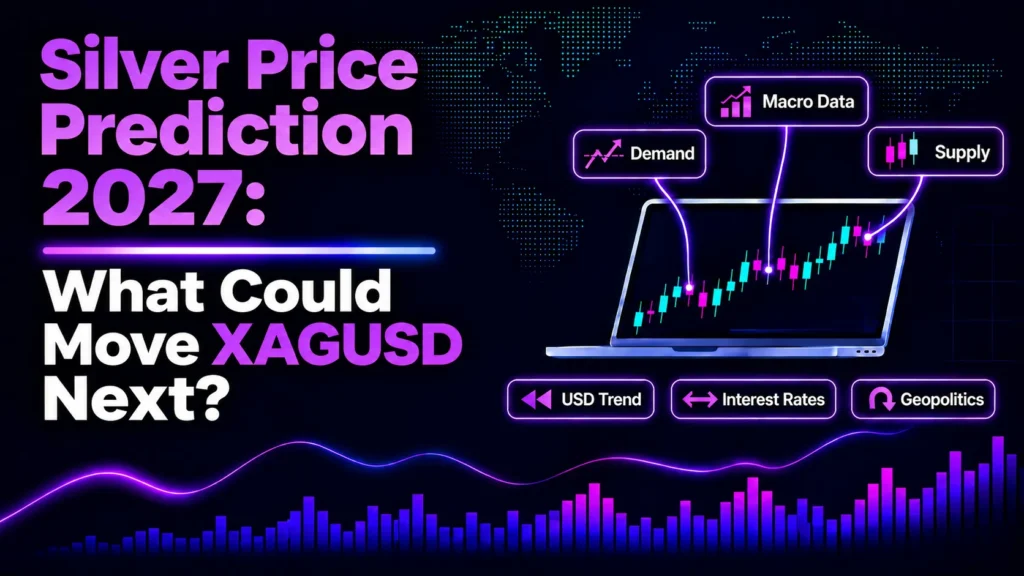
Silver price prediction for 2027 depends on whether demand remains strong enough to absorb available supply and support investor interest. Silver could gain value if buyers become more active, but weaker manufacturing demand or restrictive financial conditions could push prices lower.
Unlike gold, silver has a substantial industrial role. Manufacturers use it in electrical components, solar equipment, and various technologies. At the same time, investors trade silver as a precious metal.
This creates an unusual market: a development that encourages investors to buy silver may coincide with economic conditions that weaken industrial demand.
For anyone following XAGUSD, the useful question is not simply, “How high will silver go?” It is, “What would need to happen for the price to move higher or lower?”
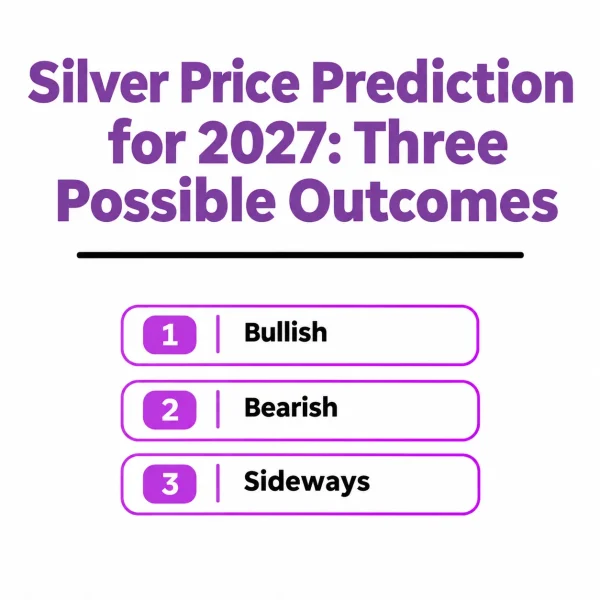
Silver Price Prediction for 2027: Three Possible Outcomes
A meaningful forecast should explain what might change the market’s direction.
Instead of relying on an exact future price, traders can compare three possible situations.
|
Market outlook |
Possible development |
What to examine |
|
Bullish |
Demand remains resilient while available supply is tight |
Buying activity and sustained upward price movements |
|
Bearish |
Industrial demand weakens or financial conditions become restrictive |
Selling pressure and breaks below established price levels |
|
Sideways |
Buyers and sellers respond to conflicting economic developments |
Repeated movements between support and resistance |
These are conditional scenarios, not predictions that a particular outcome will occur.
Bullish Silver Price Prediction: What Would Support a Rise?
A stronger silver market would likely require continued interest from investors or industrial buyers.
Supply constraints could reinforce that interest if demand cannot be met easily.
A more supportive interest-rate environment might also improve sentiment toward precious metals.
However, a shortage in the physical market does not automatically produce a steady rise in the trading price. Investor behaviour, existing inventories, and expectations can influence short-term movements.
Bearish Silver Price Prediction: What Could Cause a Decline?
Silver could struggle if manufacturers reduce purchases during weaker economic conditions.
The price may also face pressure if investors prefer assets that offer interest income or if the US dollar becomes stronger.
A bearish interpretation becomes more convincing when the price repeatedly fails to recover after declines.
Even then, sudden reversals remain possible..
Neutral Silver Price Prediction: What If Silver Stays Range-Bound?
Not every important market development creates a lasting trend.
Silver may respond positively to supply concerns, then lose momentum when economic reports suggest weaker demand.
If neither buyers nor sellers maintain control, XAGUSD may fluctuate within an established price range.
For beginners, identifying a market without clear direction can be just as useful as finding a possible entry.
Silver Price Forecast: Why Industrial Demand Matters
Silver’s role in manufacturing makes its outlook different from that of many other assets.
A company producing electrical equipment may need silver because of its conductive properties. Investors, however, may buy or sell the metal for entirely different reasons.
As a result, industrial activity and investment sentiment do not always move together.
Demand Can Change Without an Obvious Price Signal
A rise in industrial production may support silver consumption, but manufacturers can also change how much metal they use in each product.
They may redesign components, improve production methods, or investigate substitutes.
This means growth in an industry does not necessarily create an equal increase in silver consumption.
Supply Does Not Respond Immediately
Silver production has its own challenges.
Some silver comes from mines focused primarily on other metals. Production decisions at those mines may depend more on copper, lead, or zinc markets than on silver prices alone.
Recycling can add material to the market, but the amount available depends on collection, processing costs, and economic incentives.
The Silver Institute’s market update provides context on recent supply-and-demand conditions.
The main point for a 2027 forecast is that supply and demand can adjust in different ways and at different speeds.
Why Can Silver Rise While the Dollar Falls?
XAGUSD expresses the value of silver in US dollars.
When the dollar changes in value, the cost of silver for buyers using other currencies can also change.
For instance, a weaker dollar may make silver less expensive for some international purchasers, potentially supporting demand.
But this relationship is not automatic.
Silver may still decline during a weaker-dollar period if industrial demand falls or investors reduce their exposure.
Interest Rates Add Another Layer
Silver does not provide regular interest payments.
When investors can earn attractive yields elsewhere, precious metals may face competition for investment funds.
A shift toward lower interest-rate expectations can sometimes improve sentiment toward silver.
Yet the reason rates are changing matters. If borrowing costs fall because the economy is weakening, that same weakness may hurt industrial demand.
This is why silver price analysis should examine the economic context instead of treating one announcement as a guaranteed buy or sell signal.
XAGUSD Forecast: What Should Traders Look for on a Chart?
Economic analysis can explain why silver might move, but the chart shows how market participants are responding.
Three observations can help beginners organise that information.
Where Has the Market Changed Direction?
Start by identifying areas where silver previously stopped falling or struggled to rise.
These areas are commonly described as support and resistance.
Rather than treating them as exact prices, consider them zones where market interest has changed before.
A price move beyond either zone may be significant, but it can also reverse quickly.
Is the Recent Trend Still Intact?
An upward trend is more convincing when buyers continue supporting higher price levels after temporary declines.
A downward trend may persist when attempted recoveries repeatedly lose strength.
Moving averages can make such patterns easier to see, although they reflect earlier price movements.
Traders studying candlestick patterns for beginners can also examine how individual candles show buying and selling activity.
Is the Price Move Supported by Broader Conditions?
A sharp movement deserves closer examination before being interpreted as a new trend.
Consider whether the move followed economic news, occurred near a major chart level, or reflected a temporary change in market liquidity.
An isolated candle is rarely enough to establish the direction of the next trading session.
Silver Price Outlook vs Gold: Are the Metals Telling the Same Story?
Gold and silver are frequently discussed together, but comparing their prices requires care.
Gold attracts substantial attention as a reserve and investment asset.
Silver also attracts precious-metal investors, yet industrial demand plays an important role in its market.
Consider an economy facing weaker manufacturing activity but heightened financial uncertainty.
Gold might attract additional investor attention, while silver faces competing pressures from investment demand and industrial concerns.
Understanding the Gold-to-Silver Ratio
The gold-to-silver ratio expresses how much silver would be needed to equal the value of an ounce of gold.
When the ratio rises, gold has strengthened relative to silver.
When it falls, silver has improved relative to gold.
The ratio may highlight changes in their relative performance, but it does not show that one metal must immediately rise or fall.
Readers comparing precious-metal markets can place this alongside the factors discussed in precious metals trading.
How to Evaluate a Future Silver Price Prediction
Before trusting any silver forecast, examine the reasoning behind it.
A useful forecast should explain which assumptions matter and how the conclusion might change if those assumptions prove incorrect.
For example, a bullish view based on industrial growth should also consider what happens if manufacturers reduce purchases.
A forecast based on falling interest rates should examine whether economic weakness might offset the expected benefit.
A practical review can follow these steps:
- Identify the main claim. Is the forecast expecting higher prices, lower prices, or consolidation?
- Find the supporting evidence. Does it rely on supply, economic conditions, chart behaviour, or a combination?
- Question the assumptions. Which unexpected event could weaken the forecast?
- Observe the current market. Does XAGUSD price behaviour support the suggested outlook?
- Consider the trading product. Physical bullion, silver futures, and CFDs involve different costs and obligations.
- Define the potential loss. Consider whether the exposure remains manageable if the forecast fails.
Traders using exchange-traded contracts should consult the CME Group silver futures specifications to understand contract terms and trading arrangements.
The purpose is not to eliminate uncertainty. It is to recognise uncertainty before making a financial decision.
Silver Market Forecast: Risks Beginners Should Not Ignore
Silver can experience rapid price changes when economic news or trading activity shifts.
A forecast may become less useful after an unexpected central-bank announcement, supply disruption, or change in industrial expectations.
Leveraged positions introduce additional concerns because relatively small price movements can create substantial financial losses.
Trading costs also matter. Spreads may widen during less liquid periods, and stop-loss orders may execute at worse prices than expected.
Beginners can benefit from observing market behaviour through a demo account before deciding whether real-money trading is appropriate.
Most importantly, an attractive silver price outlook is not a reason to risk money needed for essential expenses.
Conclusion
A useful silver price prediction for 2027 should explain what might strengthen or weaken the market rather than promise an exact price.
Industrial consumption, silver availability, US monetary policy, and investor sentiment may all influence XAGUSD. Their effects can also conflict.
For beginners, following these developments alongside chart behaviour provides a more balanced way to assess the silver market.
Carl Dupoin publishes market analysis and trading education that readers can consider alongside independent research when developing their understanding of precious metals and trading risk.
Risk Disclaimer: Silver investing and trading involve financial uncertainty. Futures and leveraged CFDs can produce substantial losses, including losses amplified by leverage. Market forecasts, chart patterns, and past performance do not guarantee future results. This article is educational and does not provide personalised financial advice.
FAQ's
There is no certain price outcome. Industrial consumption, available supply, interest-rate expectations, and investor sentiment could influence silver's direction.
Yes. A rise is possible if demand remains resilient and buyers continue supporting higher prices, but unfavourable developments could produce the opposite result.
XAGUSD is the market quotation showing the value of silver relative to the US dollar.
Silver is used in manufacturing and technology, so changes in production and material requirements can affect demand for the metal.
Yes. Dollar strength may influence international purchasing costs and investor behaviour, although silver does not always move in the opposite direction.
Silver can experience pronounced price swings because its market responds to both investment decisions and changes in industrial activity.
No. Current inventories, demand changes, market expectations, and investor transactions also influence prices.
It is a view that prices may decline, usually based on expectations about economic conditions, market demand, or weakening chart behaviour.
Yes. Support, resistance, trends, and candlestick patterns can help organise observations, but they cannot predict prices with certainty.
No. Comparing different scenarios and understanding their assumptions provides a broader view than relying on one forecast.