

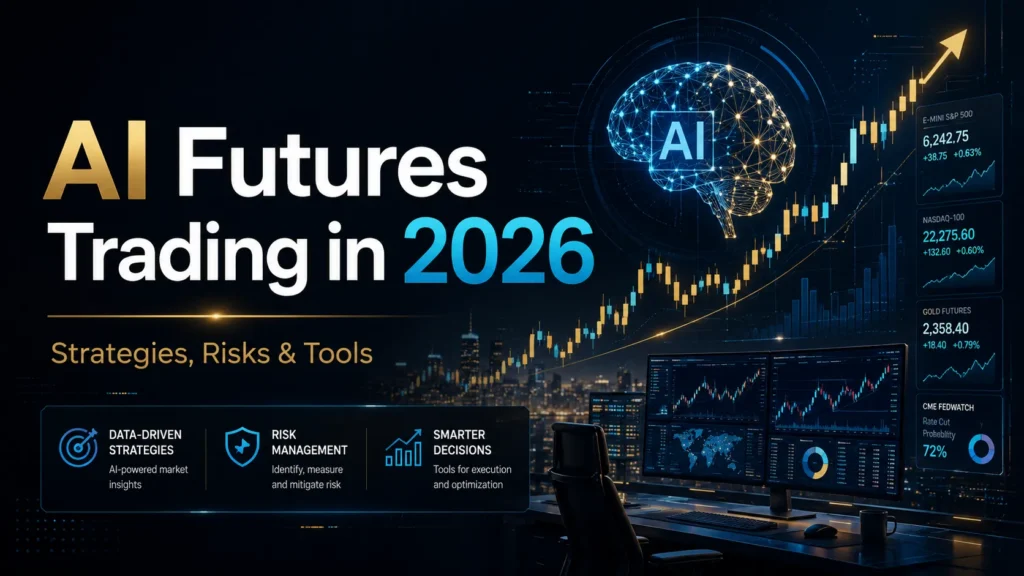
Artificial intelligence is changing how traders research markets, analyse price action and manage large amounts of trading data. Futures markets are no exception.
AI futures trading refers to using artificial intelligence, machine learning or data-driven algorithms to assist with futures market analysis, signal filtering, risk management or trade execution.
The attraction is easy to understand. Futures markets can move quickly, react sharply to economic news and trade across long sessions. An AI system can analyse more information than a trader could reasonably process manually.
But AI does not remove uncertainty.
The U.S. Commodity Futures Trading Commission has specifically warned traders that artificial intelligence cannot predict the future or sudden market changes. Traders should therefore view AI as an analytical tool rather than a guaranteed way to generate profits.
So where can AI actually help futures traders?
What Is AI Futures Trading?
AI futures trading combines market data with algorithms designed to identify patterns, classify market conditions or support trading decisions.
Traditional algorithmic trading usually follows fixed rules.
For example:
Buy when the 20-period moving average crosses above the 50-period moving average.
An AI-driven system may analyse considerably more information before accepting that same trade, including:
- volatility
- market momentum
- historical price behaviour
- volume
- time of day
- correlations
- economic events
- previous performance under similar conditions
Instead of asking only whether a technical signal appeared, the system may attempt to determine whether the environment surrounding that signal is favourable.
This is one reason traders searching for futures trading AI are increasingly interested in tools that combine technical analysis with automated data processing.
How AI Trading Futures Strategies Work
Most practical AI trading futures applications fall into a few categories.
1. Market Pattern Recognition
AI models can analyse historical price data to identify recurring behaviours.
For example, a model could examine thousands of previous breakout situations and determine whether certain volatility, momentum or volume conditions historically produced better results.
This does not mean the next breakout will succeed. It simply gives the trader more information for evaluating the setup.
Technical tools remain useful in this process. Traders who want to understand the underlying indicators first can read our guide to the Best Forex Trading Indicators.
2. Trade Signal Filtering
Another useful application is filtering trading signals.
Suppose a normal trading strategy generates 20 setups during a week. Instead of trading all 20, an AI model could rank them according to historical market conditions.
The goal is not necessarily to discover more trades.
It may be to eliminate weaker ones.
This is where artificial intelligence trading strategies can potentially complement traditional technical analysis rather than replace it.
3. Market Sentiment Analysis
Markets respond to more than chart patterns.
Inflation reports, central-bank decisions, employment data and geopolitical developments can quickly change market expectations.
Natural-language-processing systems can analyse news, reports and other text-based information much faster than a human trader.
A trader might therefore use AI to organise market information before manually deciding whether a technical setup still makes sense.
4. Risk Management
Risk management may be one of AI’s more practical applications.
An AI-assisted system can potentially identify changes in volatility and warn a trader when:
- position size appears excessive,
- market volatility has increased,
- a stop-loss distance is unusually small,
- several positions create similar exposure,
- market conditions differ significantly from the strategy’s historical environment.
This matters particularly in leveraged markets.
CME Group’s futures education explains that futures leverage allows traders to control relatively large contract exposure with smaller margin requirements. The same leverage that increases capital efficiency can also magnify losses.
AI Futures Trading vs Traditional Algorithmic Trading
AI trading and algorithmic trading are related, but they are not exactly the same.
Traditional algorithms generally execute predefined instructions.
An example might be:
IF: price breaks yesterday’s high
AND: RSI is above 55
THEN: enter a long position.
AI systems can introduce another layer by analysing whether similar conditions historically performed differently during high volatility, low liquidity or specific market sessions.
That flexibility can be useful, but it also creates additional complexity.
More sophisticated technology does not automatically mean a better strategy.
Retail traders sometimes assume that a complex model must outperform a straightforward trading system. In reality, a simple strategy with disciplined risk management may be more useful than a sophisticated model the trader does not understand.
Can AI Be Used for Gold Futures Trading?
Gold is particularly interesting because it exists across several trading environments.
Traders may access gold through futures, physical markets, exchange-traded products or instruments such as XAU/USD depending on their broker and jurisdiction.
Gold often reacts to interest-rate expectations, U.S. dollar movement, inflation expectations and geopolitical uncertainty.
AI can help traders process some of these variables, but understanding the underlying market remains important.
If gold is your main market, our guide to Precious Metals Trading provides additional background on how traders approach metals markets.
Automated trading is also increasingly popular among XAU/USD traders. Our comparison of the Best Gold EA for MT5 explains how automated gold trading systems differ and what traders should evaluate before using them.
The Biggest Risks of AI Futures Trading
AI can make trading workflows faster, but it creates risks of its own.
Overfitting
A strategy may perform extremely well on historical data because the model has effectively learned the past rather than discovered a repeatable market relationship.
When conditions change, performance can deteriorate.
Poor Data
AI depends heavily on its inputs.
Incorrect, incomplete or delayed data can produce unreliable outputs regardless of how advanced the underlying model appears.
Changing Market Conditions
Markets move through different regimes.
A strategy developed during a trending environment may perform poorly during sideways trading. A model trained during relatively normal volatility may behave differently during major economic or geopolitical events.
Excessive Automation
Automation can reduce emotional decision-making, but blindly allowing software to control risk can create another problem.
Position limits, maximum losses and shutdown conditions should still be defined.
Unrealistic Marketing Claims
Perhaps the biggest warning sign is the promise of effortless or guaranteed returns.
The CFTC’s advisory on AI trading bots specifically warns investors about claims that AI-powered bots, algorithms or trading systems can produce unreasonably high or guaranteed returns.
No legitimate AI system knows the future.
Do Traders Need AI Trading Classes?
Not necessarily.
AI trading classes may help traders understand machine learning, data analysis and automated strategy development, while algorithmic trading courses can be valuable for traders who want to build their own systems.
However, learning Python or machine learning should not come before understanding the market itself.
A sensible progression is:
- Learn how markets and orders work.
- Understand technical and fundamental analysis.
- Build basic risk-management rules.
- Learn how trading signals are constructed.
- Backtest simple strategies.
- Introduce automation or AI gradually.
- Test extensively before risking meaningful capital.
AI becomes much more useful when the trader already understands what the technology is analysing.
AI Should Support the Trader, Not Replace the Trading Plan
The strongest use case for AI futures trading is probably not asking a machine to predict tomorrow’s price.
It is using technology to improve a defined process.
AI can help organise information, analyse large datasets, filter setups and identify changing conditions. Human traders can then apply market context, risk limits and judgment.
The same principle applies to trading signals.
A quality signal should provide structure—such as direction, entry, stop loss and target—rather than encouraging traders to follow a prediction blindly. If you want to understand how structured alerts work, read our guide on What Is Forex Trading Signals?.
For traders who do not want to build complicated AI models or spend every session monitoring charts, professionally structured Forex and Gold analysis can offer a more practical way to stay informed.
Carl Dupoin focuses on clear market analysis, defined trading levels and disciplined risk management so traders remain in control of every decision.
Final Thoughts
Artificial intelligence will continue to influence trading technology, but AI futures trading should not be confused with guaranteed automated profits.
Its real value lies in processing data efficiently, identifying patterns, filtering potential setups and supporting risk decisions.
The trader still needs to understand market structure, volatility, leverage and risk.
Use AI to improve the quality of your process—not to remove responsibility for the trade.
For many traders, the best combination may ultimately be straightforward: technology for speed, professional analysis for context and disciplined risk management for capital protection.
FAQ's
AI can help futures traders analyse data, classify market conditions, filter trading signals and review risk. It cannot guarantee profitable trades or accurately predict every market move.
Some trading platforms allow algorithms or AI-assisted systems to generate and execute orders. Automated execution should still include strict position sizing, loss limits and monitoring.
AI alone does not make a trading strategy profitable. Results depend on the strategy, data quality, execution costs, market conditions and risk management.
Algorithmic trading normally follows predefined rules, while AI systems may use machine learning and other techniques to identify patterns or adapt their analysis based on data.
Yes, but beginners should first understand market basics, trading risk and position sizing. AI is more useful when the trader understands the strategy the technology is supporting.