What is leverage in forex? Leverage allows traders to control a larger currency position with a smaller amount of money. Instead of paying the full value of a trade, traders provide a deposit called margin.
For example, leverage of 10:1 allows a trader to control a $1,000 position using $100 in margin. However, profits and losses depend on the full position value, not just the deposit.
Leverage is commonly used in forex trading, but it increases financial risk. Before using it, traders should understand basic forex trading strategies and how position sizes affect potential losses.
This guide explains how leverage works, its benefits, risks, and mistakes beginners should avoid.
What Is Leverage in Forex Trading?
Forex leverage is a trading feature that allows traders to open positions larger than their available margin.
It is expressed as a ratio, such as 10:1, 20:1, or 50:1. The ratio shows how much market exposure a trader can control compared with the required margin.
For example, at 20:1 leverage, a trader may open a $2,000 currency position using $100 as margin.
According to IG’s explanation of leverage, leveraged positions increase exposure to price movements, meaning both potential profits and losses become larger relative to the initial deposit.
Leverage does not make a trading strategy more accurate. It changes the amount of market exposure a trader can take.
How Does Leverage Work in Forex?
When traders open a leveraged position, the broker requires a portion of the trade value as margin.
The remaining exposure is provided through the broker’s leveraged trading arrangement.
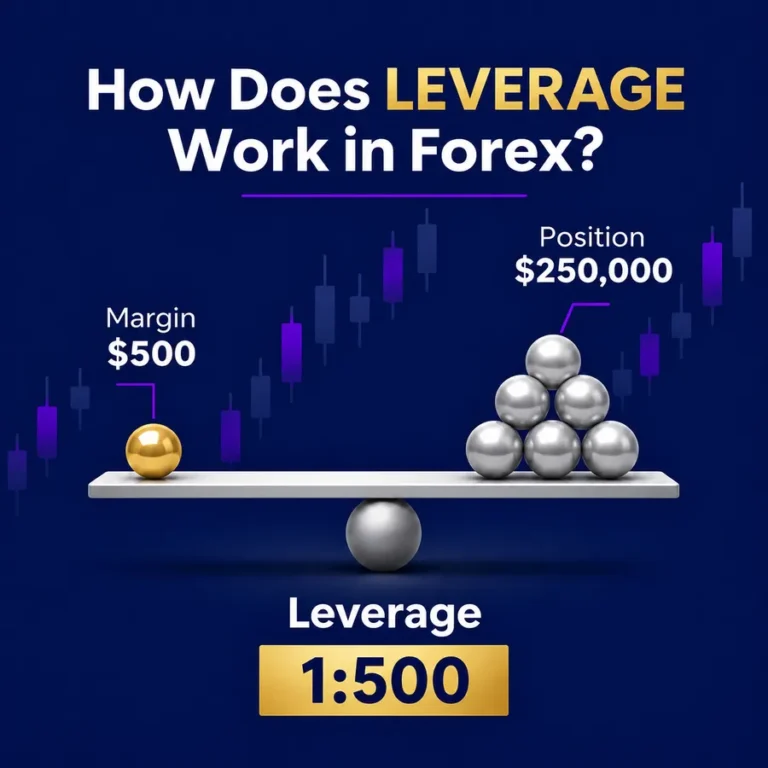
Forex Leverage Example
Suppose a trader wants to open a position worth $5,000.
With 10:1 leverage, the required margin would be $500.
If the position gains $50, the trader earns $50 before trading costs. If it loses $50, the trader loses the same amount.
The profit or loss comes from the position’s total value and price movement.
Higher available leverage does not require a trader to open larger positions. Actual risk depends on position size, market movement, and account conditions.
What Is Margin in Forex?
Margin is the amount of money a broker sets aside to open and maintain a leveraged trade.
It is not normally a separate trading fee. Instead, it acts as collateral while the position remains open.
The relationship is simple:
Required Margin = Position Value ÷ Leverage Ratio
For example, a $10,000 position at 20:1 leverage requires $500 in initial margin, excluding additional broker requirements.
The OANDA guide to forex leverage and margin explains how margin requirements affect the positions traders can open and maintain.
Benefits of Leverage Trading
Leverage provides greater market exposure without requiring traders to fund the full position value.
1. Lower Initial Margin
Traders can open eligible positions with less upfront capital than would otherwise be required.
This may provide flexibility, but the smaller deposit should not be confused with lower risk.
2. Flexible Position Management
Available leverage allows traders to choose different position sizes within broker requirements.
However, selecting a smaller position is often more important than using the maximum leverage available.
3. Access to Different Markets
Leveraged products may provide access to forex pairs, indices, and commodities, depending on the broker.
For example, precious metals trading may involve leveraged gold or silver CFDs, which carry additional market and financing risks.
Risks and Disadvantages of Forex Leverage
Leverage increases exposure to market movements. Even a small price change can have a large effect on a trader’s account.
Larger Trading Losses
Losses are calculated using the full position value rather than only the initial margin.
Higher leverage can therefore reduce account equity quickly when a trader opens a position that is too large.
Margin Calls and Stop-Outs
A margin call occurs when account equity falls below the broker’s required level.
A stop-out may automatically close positions when account funds become insufficient to maintain them.
Exact rules depend on the broker and applicable regulations.
Market Volatility
Economic announcements and unexpected financial events can cause rapid price movements.
During volatile periods, orders may execute at different prices than expected. This is called slippage.
Traders using forex trading indicators should remember that technical signals cannot prevent losses caused by sudden market movements.
Common Forex Leverage Trading Mistakes
1. Using Maximum Leverage
Some beginners assume that higher leverage means greater profit potential without considering additional losses.
Using the maximum amount available can expose an account to more risk than the trader intended.
2. Trading Without a Stop-Loss
A stop-loss is an instruction to close a position when a specified price is reached.
It can help limit losses, but execution at the exact stop price is not guaranteed, especially during volatile markets.
3. Ignoring Position Size
A trader may choose a reasonable entry price but still lose heavily because the position is too large.
Position size should reflect account funds, stop-loss distance, and the amount the trader can afford to risk.
4. Overtrading After Losses
Opening larger positions to recover previous losses can quickly increase financial exposure.
A forex trading journal can help traders review their decisions, identify repeated mistakes, and monitor risk-taking habits.
How to Use Leverage Responsibly
Traders should approach leverage with a clear risk management plan.
-
- Start with a demo account to understand margin requirements.
-
- Choose a position size based on planned risk, not maximum available leverage.
-
- Set stop-loss levels based on market conditions.
-
- Check spreads, commissions, and overnight financing charges.
-
- Monitor available margin and account equity.
-
- Avoid increasing exposure simply to recover losses.
There is no universally safe leverage ratio. Suitable exposure depends on trading experience, account size, market conditions, and risk tolerance.
Conclusion
Understanding what leverage is in forex helps traders recognise how margin, position size, and market exposure work together. Leverage offers flexibility but also increases the potential for financial losses.
Before using leverage, develop a trading plan, understand broker requirements, and record your decisions. Applying disciplined forex trading strategies can help you approach leveraged markets with clearer risk limits.
FAQ's
Forex leverage lets beginners control currency positions larger than their initial margin deposit. It increases market exposure and can magnify both profits and losses.
High leverage can create significant risk if traders open oversized positions. Beginners should focus on controlling trade size rather than using the maximum available leverage.
Leverage describes the ratio between market exposure and required margin. Margin is the deposit needed to open and maintain a leveraged position.
Yes, depending on the broker and account conditions. Trading without leverage requires more capital to control the same position size.
Yes, losses may exceed the initial margin. Whether losses can exceed the total account balance depends on the product, broker, jurisdiction, and any negative balance protection.